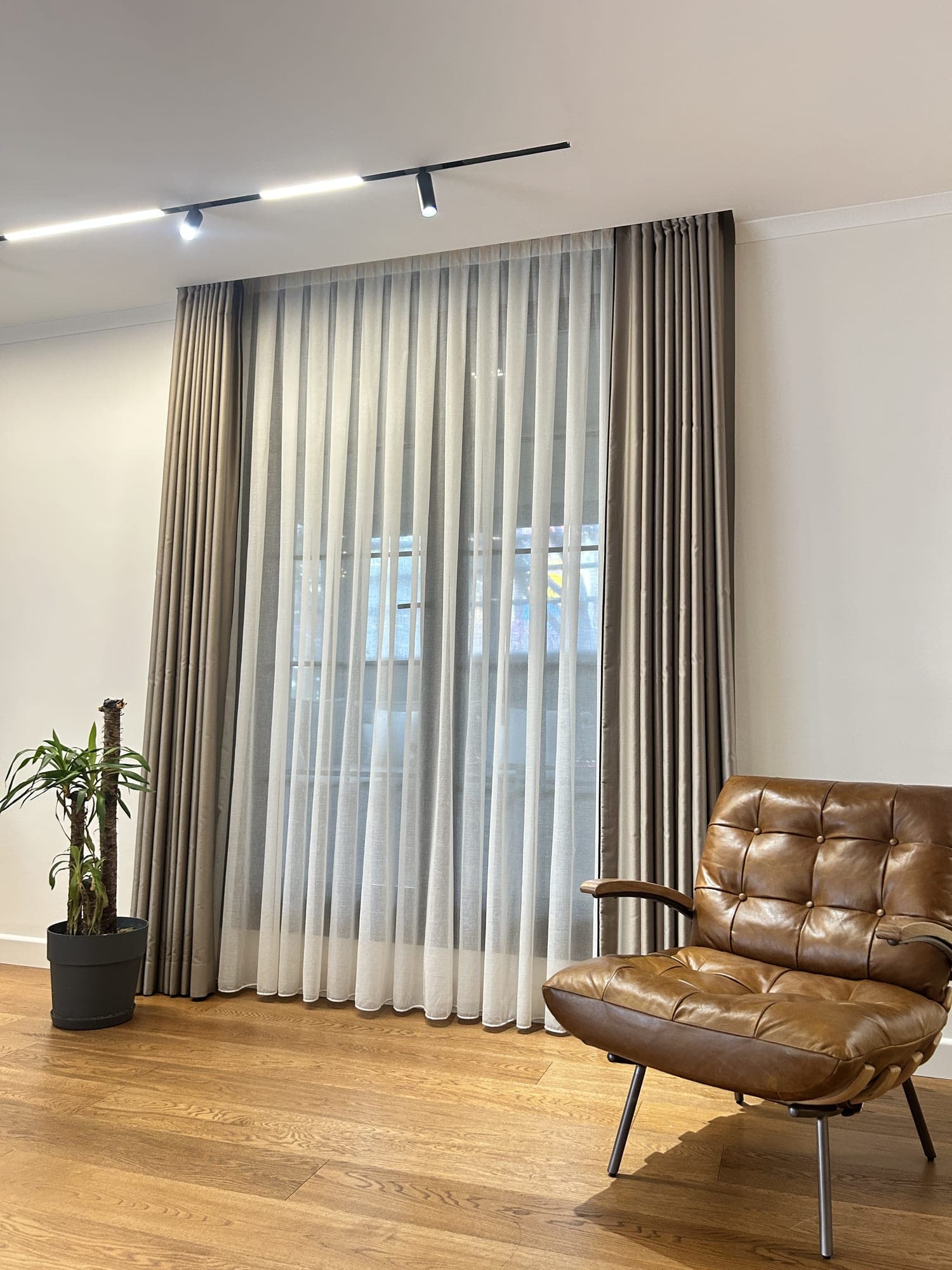
Drapes
It frames the window on either side of the sheer and, drawn in the evening, shuts out the light and passing eyes. Its colour and texture set the mood of the room. The photographs below are drapes we have fitted.
PhotographsThe room's frame
- Fabric
- Velvet, linen, jacquard, textured
- Heading
- Wave or classic heading
- Fitting
- Track, rail or pole
- Ready in
- 3–8 working days
- Guarantee
- 3 years
A drape is a curtain sewn from a heavier, textured fabric that hangs either side of the sheer or in front of it. By day it frames the window and warms the room; drawn in the evening, it shuts out light and eyes. With its colour and texture it is one of the strongest textiles in a room.
Fabric options
Velvet, linen, textured and jacquard fabrics give a drape very different characters. Blackout fabrics cut the light in bedrooms; lined drapes fall better and reduce the cold from the window. You choose your fabric from our sample books, beside your own furniture and walls.
Heading, length and hanging
A drape can hang as the second layer on the sheer's track or on its own. Headings that give even waves draw a calm line in modern rooms; classic headings look fuller. On a track set into the ceiling the curtain falls from ceiling to floor in one line; a pole makes the hanging part of the décor.
Tiebacks and border bands
By day an open drape can be gathered to the side with a tieback of wooden beads or a holdback fixed to the wall. A band of another colour sewn along its edge draws a fine frame round the drape and, like the cinnamon band in the photographs, carries one of the room's colours to the window.
Sewing, fitting and guarantee
Your drapes are sewn in our own workshop to the measurements we take in your home, and orders are ready within 3–8 working days. Our own team fits tracks, rails and poles. Like all our products, our drapes carry a 3-year guarantee, and our washing and care support goes on after delivery.
Photographs
Living and dining rooms
Bedrooms
Fabric and texture
Headings, poles and tiebacks
Product films are being shot.
Frequently asked questions
Will a drape make the room completely dark?
A drape sewn from blackout fabric, or lined with blackout, stops the light that passes through the fabric. To cut the light that leaks round the edges and over the top, we recommend a drape wide enough to overlap the window on every side, fitted close to the ceiling.
Do drapes help with insulation?
Heavy, lined drapes form a layer between the window and the room when drawn, reducing the cold from the glass in winter and the sun's heat in summer. How much depends on the fabric and on how fully the curtain wraps the window.
How is a drape's width worked out?
For a drape to look full, its fabric is kept wider than the track is long; the ratio depends on the heading chosen. We set the right ratio when we measure, looking at the window and the weight of the fabric.
Does a drape hang from the ceiling or the wall?
Either. If the ceiling has a recess or a curtain box, the track is hidden in it and the drape falls from ceiling to floor in a single line. Without one, a track or rail is fixed to the ceiling or the wall, while a pole goes on the wall and stays in view as part of the décor. We decide together which suits when we measure.
How is a drape's length decided?
We settle the length with you when we measure. A drape made to just touch the floor draws a straight line from ceiling to floor. A hem that breaks softly on the floor looks more classic but is harder to clean. A length that stops just above the floor suits drapes that are opened and closed often.
How are drapes cleaned?
Dusting the fabric regularly with a soft brush or a vacuum cleaner on low suction is enough. Whether to wash or dry-clean depends on the fabric; for velvet and lined drapes we recommend professional cleaning. Our care support goes on after delivery.
Curtain Systems
All productsGet a quote for your project
How many windows, which space, what date? Send us a line and we'll book a measuring visit.